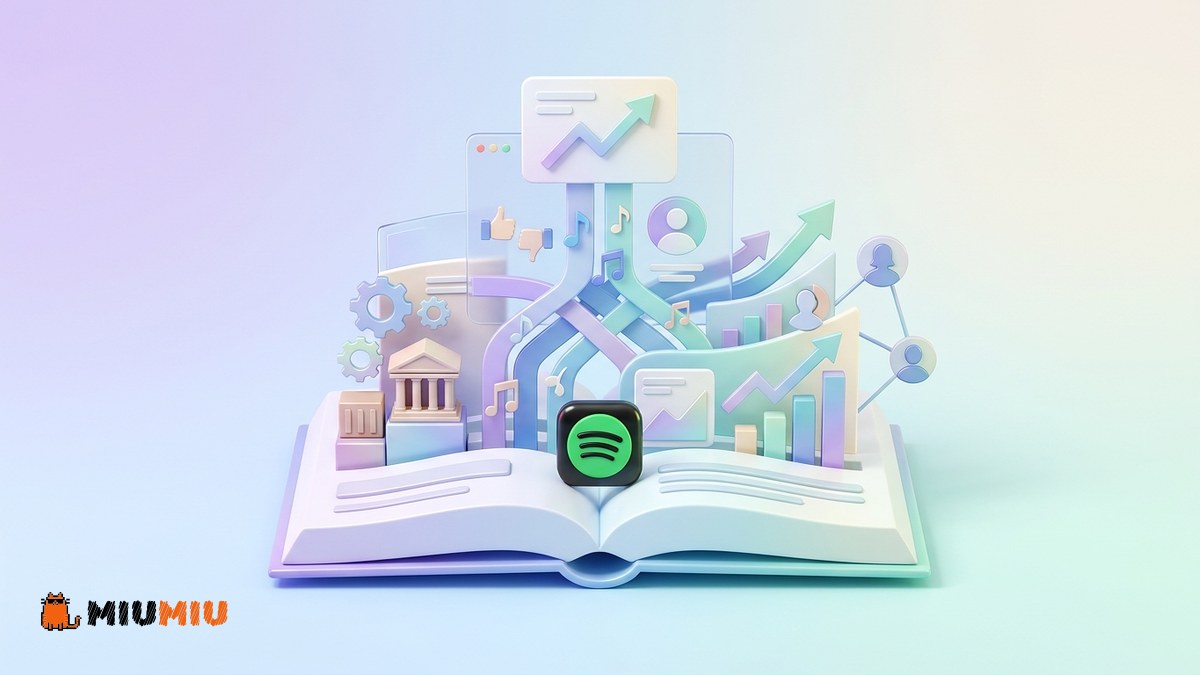
What is Spotify? A Direct Answer
Spotify is the world's leading audio streaming subscription service, dominating the global digital music market with over 761 million monthly active users (MAUs) and 293 million premium subscribers. Operating under a freemium business model, the Swedish-born platform grants users instant access to an expansive library of over 100 million musical tracks and approximately 7 million podcast titles. While the ad-supported free tier imposes constraints like lower audio fidelity, restricted skip capabilities, and intermittent ads, the Premium subscription delivers high-fidelity sound, unrestricted playback control, and seamless offline listening.
The History of Spotify: Rescuing the Music Industry from Piracy
In the early 2000s, the global music industry was on the verge of financial collapse due to rampant online copyright infringement facilitated by peer-to-peer (P2P) file-sharing networks such as Napster and Limewire. Recognizing the urgent need for a legitimate, high-speed, and frictionless alternative, Daniel Ek, the former CEO of uTorrent, teamed up with Martin Lorentzon, the co-founder of the successful digital advertising firm TradeDoubler.
The duo founded Spotify on April 23, 2006, in Stockholm, Sweden. Their founding thesis was simple: to construct a platform so fast and convenient that listeners would naturally choose it over illegal downloads. Following two years of complex negotiations to secure licensing agreements from major record labels (Universal Music Group, Sony Music, and Warner Music Group) in exchange for an aggregate 20 percent equity stake in the startup, Spotify officially launched on October 7, 2008, in selected European territories.
Major Historical Milestones and Strategic Acquisitions
Spotify's journey from a European startup to an international audio behemoth is defined by pivotal product launches and aggressive horizontal integrations:
- The United States Expansion (2011): Overcoming severe regulatory and licensing barriers, Spotify's launch in the US marked the beginning of its global hyper-growth.
- The Echo Nest Acquisition (2014): By purchasing the music intelligence startup The Echo Nest for approximately 100 million dollars, Spotify integrated advanced acoustic and behavioral metadata into its database, laying the technological foundation for its recommendation systems.
- The Launch of Discover Weekly (2015): This algorithmic playlist, which serves 30 highly personalized song recommendations every Monday, became a massive retention multiplier and industry benchmark.
- Direct Listing IPO (2018): In April 2018, Spotify bypassed traditional underwriting by launching a Direct Listing on the New York Stock Exchange (NYSE) under the ticker SPOT, achieving a first-day market cap of over 26 billion dollars.
- The Podcast Expansion (2019 onward): Spotify aggressively expanded beyond music by acquiring podcast hosting giant Anchor alongside creative production houses Gimlet Media and Parcast in 2019. It subsequently bought Megaphone in 2020 to build a robust proprietary audio advertising marketplace.
- Audiobooks and Findaway (2021): Spotify entered the audiobook market by acquiring the digital distributor Findaway, establishing a third major content pillar.
- The AI DJ Launch (2023): Driven by large language models and generative voice synthesis, the AI DJ curates personalized music streams paired with realistic radio-style commentary.
Today, the parent holding entity Spotify Technology S.A. is registered in Luxembourg, while the operational headquarters and core product development divisions remain located in Stockholm, Sweden, led by co-founder Daniel Ek.
The Spotify Ecosystem and Core Features
The platform is engineered as a multi-sided ecosystem designed to serve both audio consumers and content creators simultaneously through specialized tools:
1. Audio Catalog & Curation
With an extensive database of over 100 million songs and 7 million podcasts, Spotify serves as a global sound library. Listeners benefit from synchronized lyrics, group session capabilities, collaborative playlists, and the annual "Spotify Wrapped" campaign, which turns yearly listening statistics into a viral social media event every December.
2. Spotify for Artists
An administrative portal allowing independent artists and labels to claim their official blue-verified profiles, update bio statements, promote concert tours, sell merchandise directly, and analyze granular, real-time demographic data of their listeners.
3. Spotify for Podcasters
Following the consolidation of Anchor, this unified portal allows creators to host, distribute, monetize, and analyze their video and audio podcasts seamlessly.
Under the Hood: How Spotify Works Technically
Historically, Spotify utilized a peer-to-peer (P2P) delivery model to offset bandwidth costs. Today, Spotify relies on modern Cloud Computing and Content Delivery Networks (CDNs) to stream encrypted DRM-protected audio. Music is encoded using the Ogg Vorbis format (at 96, 160, and 320 kbps bitrates depending on user settings and subscription tier) or AAC for web players.
The Three Pillars of the Spotify Recommendation Algorithm
The personalization engine that drives user retention is powered by three main machine learning strategies:
- Collaborative Filtering: This system maps user behavior. If User A and User B share a 90% overlapping listening history of Songs X, Y, and Z, the algorithm automatically recommends Song W (which User A loves but User B has not heard) to User B.
- Natural Language Processing (NLP): The algorithm continuously crawls internet blogs, news sites, track listings, and user-generated playlist titles to extract adjectives, cultural references, and contextual themes associated with each track, helping group music by mood.
- Raw Audio Analysis: Using deep Convolutional Neural Networks (CNNs), the system analyzes the raw audio wave file to measure technical attributes such as tempo, key, loudness, "danceability", and "acousticness". This allows Spotify to categorize and recommend newly released, obscure tracks that lack user data.
The Popularity Index
For artists, the "Popularity Index" is a critical, hidden metric ranging from 0 to 100. Rather than looking at cumulative historic streams, it prioritizes the velocity of recent streams, user save-to-library rates (Saves), and playlist additions. A high score signals the algorithm to automatically slot the track into algorithmic radio stations and user mixes.
Artist Growth on Spotify: Honest Metrics and Promotional Risks
To successfully market music on Spotify, creators must understand five core performance indicators:
- Plays: Tracked streams that have been played for at least 30 seconds.
- Monthly Listeners: The number of unique listeners who have played your music over a rolling 28-day window. This is the primary public benchmark shown on artist profiles.
- Followers: Users who have subscribed to your profile to receive updates in their automated Release Radar feed.
- Playlist Followers: The audience reach of a specific playlist containing your song.
- Saves: The number of times a user adds your song to their Liked Songs folder, indicating strong engagement.
A Transparent Perspective on SMM Growth Services
In addition to organic promotional activities, some emerging artists utilize Social Media Marketing (SMM) growth tools to accelerate their social proof. At MIUMIU, our core differentiator is absolute transparency. We do not use manipulative marketing terms. Below are the specific technical terms and limitations of the Spotify promotional services available on our storefront:
- Spotify Plays: Designed to increase the stream count of your releases. It features an average start time of approximately 60 minutes. (refill: NO | cancel: NO).
- Spotify Followers: Enhances the visual authority of your public profile. Average start time is roughly 240 minutes. (refill: NO | cancel: NO).
- Spotify Monthly Listeners: Elevates the rolling 28-day unique listener count displayed on your profile. Average start time is around 60 minutes. (refill: NO | cancel: NO).
- Spotify Playlist Followers: Ideal for boosting the authority of custom-curated public playlists. Average start time is approximately 240 minutes. (refill: NO | cancel: NO).
- Spotify Saves: Simulates the bookmarking of your track in listener libraries. Average start time is around 60 minutes. (refill: NO | cancel: NO).
Crucial Risk & Security Warning: Because all the aforementioned services operate under strict "no refill" (refill: NO) and "no cancellation" (cancel: NO) terms, any natural drops that may occur over time cannot be replenished or refunded. Modern streaming security systems are highly sophisticated. Drastic, unnatural spikes in plays without corresponding listener retention or off-platform traffic can cause algorithms to filter the streams or flag the artist profile, which may result in temporary playlist bans or the removal of releases. At MIUMIU, we strictly advise against relying solely on artificial metrics. These services should only be used in moderate quantities as a supplementary visual baseline alongside genuine organic music marketing.
Comparison Table: Organic Growth vs. SMM Promotion
| Metric | Organic Music Marketing | SMM Growth Services |
|---|---|---|
| Long-Term Retention | Very High | True fans will stream your future catalog. | None | Boosted numbers do not generate future active streams. |
| Velocity | Slow and Iterative | Requires months of active campaigns. | Rapid | Changes occur within 60 to 240 minutes. |
| Algorithmic Value | Excellent | Drives real placement on Discover Weekly. | Neutral to High-Risk | Incorrect ratios can trigger fraud filters. |
| Financial Cost | Time-intensive, but budget stays under artist control. | Variable cost, with risk of uncompensated stream drops. |
Operational Checklist for Organic Artist Growth
To establish a durable, algorithmic presence on Spotify, execute this checklist consistently:
- Verify your Spotify for Artists profile to claim your blue verification checkmark.
- Submit (Pitch) your unreleased songs to Spotify's editorial playlist team at least 3 to 4 weeks before the official release date.
- Design and upload an 8-second visual looping video (Canvas) for every single release to increase social sharing rates.
- Drive traffic from external social platforms. Learn how these networks operate by reading our deep dives, such as the Complete YouTube Channel Growth Guide and our realistic Instagram Safety Analysis.
- Incorporate Spotify Codes on physical promotional cards, gig posters, and social media banners.
Cross-Platform Synergy: Unlocking Algorithmic Favor
The Spotify algorithm prioritizes tracks that attract external referral traffic. When your music receives clicks from platforms like TikTok, YouTube, Telegram, or Instagram, Spotify registers this as organic interest and boosts your profile's internal recommendation weight. To build a cohesive digital marketing network, read our analysis on the Instagram Algorithm in 2026 and our guide on Telegram Technical Growth to design a unified cross-platform pipeline.
Frequently asked questions
Is Spotify completely free for users?
Yes, Spotify offers a freemium tier. Anyone can sign up and stream the entire music and podcast library for free. However, the free version includes audio advertisements, limits song skips, streams at lower bitrates, and prevents downloading audio files for offline listening.
What is the difference between Monthly Listeners and Followers?
Followers represent users who have clicked "Follow" on your profile, building a permanent, cumulative fan base. Monthly Listeners, however, reflect the unique number of individual users who streamed your music over a rolling 28-day window. This is a dynamic, fluid metric that rises and falls based on your current catalog activity.
Are SMM growth services safe, and are they guaranteed?
No, there are no guarantees. All Spotify-related plays, monthly listeners, and followers on MIUMIU are provided with "refill: NO" and "cancel: NO" parameters. Relying on sudden or excessive artificial growth carries risks, including stream filtering or release takedowns by Spotify's anti-fraud systems. We recommend focusing on organic curation and using SMM tools strictly as an auxiliary visual aid.
How does Spotify calculate artist royalty payouts?
Spotify does not pay a flat rate per stream. Instead, it pools subscription and advertising revenues, takes its fee, and distributes the remainder based on "Stream Share" (the proportion of an artist's streams relative to the total streams on the platform) to digital distributors and record labels, who then pay the artists based on individual contracts.
Sources & references

Writer, Content Team
I write for the MIUMIU content team, mostly about the difference between real and fake followers and the risks of buying engagement. I'll be straight with you: I tell you the risks as they are, even when it doesn't help a sale. I'd rather you know what you're getting into.