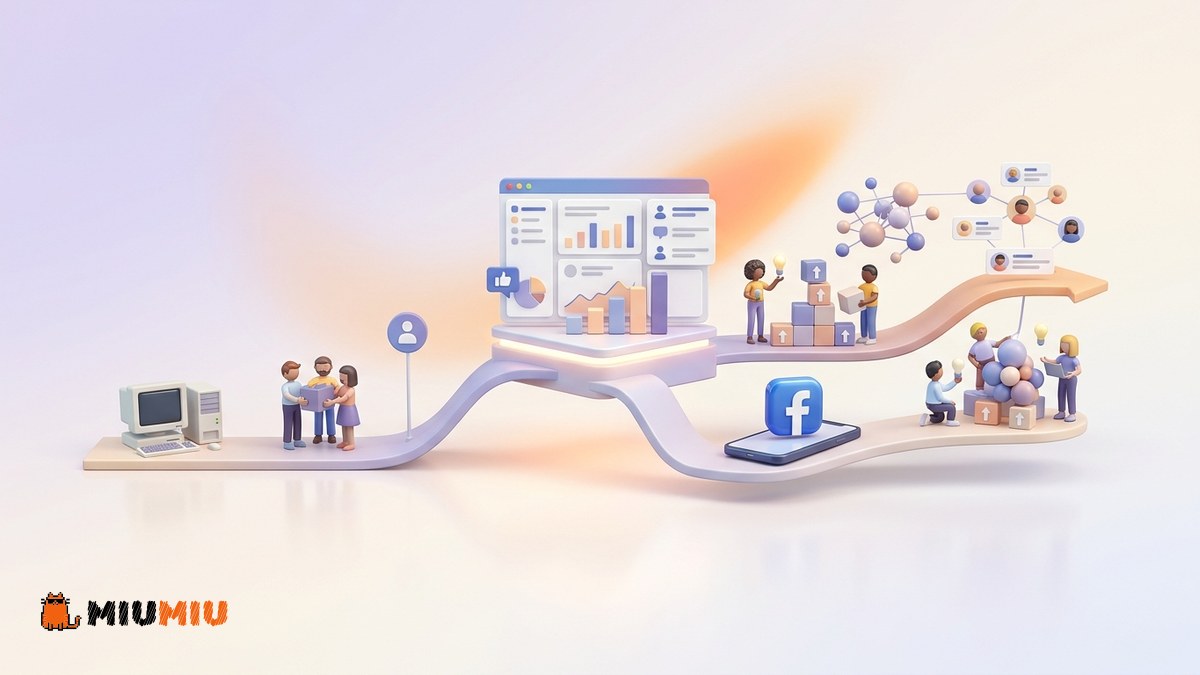
What is Facebook? A Quick Summary
Facebook is the world's largest and most established social media platform, boasting over 3 billion monthly active users. It allows individuals to build personal profiles, connect with family and friends, join interest-based groups, and share text, photos, and video content. Owned by Meta Platforms, Inc., Facebook serves as the cornerstone of a massive digital ecosystem, acting as a powerful hub for personal communication, professional networking, and business marketing worldwide.
The History of Facebook: From a Harvard Dorm to a Global Tech Empire
The rise of Facebook is one of Silicon Valley's most legendary stories. What began as a simple college directory has evolved into the most influential communication network in human history.
Founders and Launch Year
On February 4, 2004, Harvard sophomore Mark Zuckerberg launched "TheFacebook" along with his college roommates Eduardo Saverin, Andrew McCollum, Dustin Moskovitz, and Chris Hughes. The platform's original purpose was to connect Harvard students through an online directory.
Due to its immediate success, the network quickly expanded to other prestigious North American universities, including Stanford, Yale, and Columbia. In 2005, the company officially dropped the "The" from its name to become "Facebook" and opened public registration to anyone aged 13 and older with a valid email address in September 2006.
Key Milestones and Strategic Acquisitions
To maintain its market dominance, Facebook focused on rapid feature development and high-stakes corporate acquisitions:
- The News Feed (2006): This revolutionary update turned static profile browsing into a real-time, dynamic stream of updates from friends, changing how people consume social media content forever.
- The "Like" Button (2010): Introduction of the iconic thumbs-up button established a universal feedback loop and became the primary currency of online validation.
- Initial Public Offering (2012): Facebook went public, raising $16 billion at a $104 billion valuation, marking one of the largest tech IPOs in history.
- Acquisition of Instagram (2012): Facebook acquired the photo-sharing app Instagram for $1 billion. For a deeper look at this visual giant, read our Complete Guide to Instagram.
- Acquisition of WhatsApp and Oculus (2014): Buying the global messenger WhatsApp for $19 billion and virtual reality pioneer Oculus VR for $2 billion consolidated Facebook's dominance across mobile communications and future technology.
The Birth of Meta Platforms and the Current Era
In October 2021, the parent company rebranded as Meta Platforms, Inc., aligning its identity with the development of the "metaverse", virtual reality, and artificial intelligence. Today, Facebook exists alongside Instagram, WhatsApp, Messenger, and Threads under the Meta umbrella. Generating over $200 billion in annual revenue, it remains the absolute heavyweight of social media platforms.
The Facebook Ecosystem: Core Components and Features
Unlike single-purpose apps, Facebook is a multi-dimensional digital ecosystem with several key components:
1. Personal Profiles
A personal profile is an individual's digital identity on the platform. It is non-commercial, capped at 5000 friends, and designed for sharing personal updates, photos, and life milestones with friends and family.
2. Facebook Pages
Pages are public-facing profiles designed for businesses, public figures, brands, and organizations. Pages have no follower limits, provide access to in-depth audience analytics (Page Insights), and unlock Meta's robust advertising suite. Businesses looking to build instant credibility often use services like Facebook Page Followers to establish strong initial social proof.
3. Facebook Groups
Groups are highly interactive communities built around shared interests, hobbies, or local areas. They can be set to public or private. Groups have experienced a massive resurgence as users look for smaller, more meaningful spaces to interact rather than broadcasting to a public feed.
4. News Feed and Reels
The News Feed is the primary stream where users view content from friends, pages they follow, and AI-recommended posts. Facebook Reels (short-form vertical videos) are the fastest-growing content format on the platform, designed to compete with TikTok. To compare platforms, check out our guide on How TikTok Works.
5. Facebook Marketplace
A peer-to-peer commerce platform integrated directly into the app. It allows users to browse, buy, and sell items locally without transaction fees, serving over 1 billion visitors monthly.
6. Messenger
Originally a built-in chat feature, Facebook Messenger operates as a standalone communication app with over 1 billion users, handling text, voice calls, and business-to-consumer chat channels.
How the Facebook Algorithm Works in 2026
The Facebook algorithm is no longer a simple reverse-chronological feed. It is a highly sophisticated, AI-driven discovery engine that continuously predicts what users find most relevant.
The ranking system processes thousands of posts in milliseconds based on four main steps:
- Inventory: Gathering all eligible posts from friends, followed pages, joined groups, and candidate recommended posts.
- Signals: Analyzing the properties of each post, including the creator, media type, posting time, and the user's connection strength.
- Predictions: The machine learning model calculates probabilities, predicting how likely you are to spend time on the post, write a comment, or share it.
- Relevance Score: Giving every post a customized score. The highest-ranking posts appear at the top of your feed.
A major strategic shift in 2026 is that the algorithm heavily prioritizes "Private Shares" (sending a post to friends via Messenger or WhatsApp) over passive vanity metrics like standard "Likes". This deep engagement tells the AI that the content has genuine value. Additionally, over 25 percent of the content on people's feeds is recommended by Meta's AI discovery engine, showing posts from accounts they do not yet follow. This presents a massive organic growth opportunity for small, niche creators.
Who Uses Facebook and Why?
Despite misconceptions that Facebook is losing its appeal, it remains a diverse multi-generational network:
- Demographics: The largest user bracket is adults aged 25 to 34 (accounting for 31% of the audience), followed by 18 to 24-year-olds at 23.2%.
- Businesses: Over 200 million small businesses use Facebook Pages to find, nurture, and convert local and global customers.
Users stick with Facebook because of its utility: it coordinates physical events, powers local marketplace deals, hosts specialized professional groups, and keeps older and younger generations connected. This utility differs from other platforms like X (Twitter) or YouTube. For more platform comparisons, explore our guides on X (Twitter) Strategy and YouTube Growth Guide.
Comparing Facebook Tools: Profiles, Pages, and Groups
Selecting the right space for your goals is essential. The table below outlines the core differences:
| Feature | Personal Profile | Facebook Page | Facebook Group |
|---|---|---|---|
| Primary Purpose | Personal connection | Brand representation & marketing | Community discussions |
| Member Limit | Up to 5,000 friends | Unlimited followers | Unlimited members |
| Advertising Tools | None | Full access to Ads Manager | None |
| Analytics Available | Very limited | Comprehensive Page Insights | Moderate Group Insights |
| Default Privacy | Customizable (Private/Friends) | Always Public | Public or Private options |
A Step-by-Step Growth Checklist for Facebook
Navigating Facebook's vast competitive landscape requires a tactical approach. Here is a practical roadmap to grow your presence:
1. Polish Your Page Foundation
Ensure your business page contains a professional profile picture, high-resolution cover photo, completely filled "About" section, and a clear call-to-action button. An incomplete page instantly loses potential followers.
2. Feed the Discovery Engine with Reels
Because Facebook's recommended feed relies heavily on short-form vertical video, publish high-quality Reels 3 to 4 times a week. Use trending audio and engaging on-screen text to hook viewers in the first 3 seconds.
3. Dominate the First 6 Hours of Engagement
When a post goes live, reply to every single comment within the first few hours. Pose follow-up questions to keep the conversation flowing. The algorithm rewards active comment sections with higher organic distribution.
4. Encourage Shares Over Likes
Design highly shareable resources, checklists, and templates. When users share your post, it triggers the algorithm's highest-value signal, sending your content to wider, lookalike audiences.
Daily & Weekly Growth Tasks
- Monitor and respond to Messenger inquiries and comments (Daily)
- Post 1 high-quality Reel or valuable photo carousel (3 to 5 times a week)
- Analyze Page Insights to identify top-performing content (Weekly)
- Share highly relevant page posts into matching Facebook Groups with moderation (Weekly)
Transparency and Risk Management in Facebook Growth
At MIUMIU, honesty is our ultimate differentiator. We believe in providing our clients with the unfiltered truth about social media marketing rather than offering hyped claims or false guarantees.
The reality of today's social media landscape is that organic reach for Facebook Pages has dramatically declined, often dropping below 2 percent. Meta deliberately limits organic distribution to encourage brands to buy paid advertising.
Using SMM tools and promotional boosts, such as purchasing initial Facebook Likes, can help jumpstart a page's credibility. It creates "social proof", making real visitors more likely to trust your brand. However, paid engagement is not a magical cure: it does not bypass the algorithm on its own, and "100% safe" or "ban-proof" claims do not exist in the real world. To maintain a healthy account:
- Be Mindful of Refill Policies: Most Facebook SMM services, including followers, views, story views, and group members, do not offer refills or cancellations (refill: NO, cancel: NO). Only select services like shares (Facebook Shares) and reactions possess a refill policy (refill: YES, cancel: NO).
- Avoid Spam Behaviors: Do not flood a completely empty, newly created page with massive amounts of cheap artificial engagement. Rapid spikes on inactive accounts trigger security protocols, potentially leading to ad account restrictions.
- Prioritize Content Quality: Bought engagement is simply a temporary booster. Long-term, sustainable growth requires producing high-value, original content that satisfies real human audiences.
To learn more about platform security and avoiding systemic reach restrictions, check out our guides on Instagram Shadowban Explained and the Telegram Technical Overview.
Conclusion
Despite being one of the oldest social platforms, Facebook remains an essential pillar of global digital marketing. By understanding its evolving ecosystem, utilizing the power of AI recommendations, and maintaining an authentic relationship with your audience, you can unlock sustainable growth. MIUMIU is here to support you with practical advice and transparent growth tools every step of the way.
Frequently asked questions
Is Facebook still worth it for marketing in 2026?
Absolutely. With over 3 billion monthly active users and a powerful AI-driven recommended feed, Facebook continues to offer incredible reach. Leveraging Facebook Groups and vertical Reels is currently one of the most effective ways to drive organic traffic.
How does the Facebook algorithm rank content?
The algorithm uses machine learning to score posts based on four pillars: inventory, signals (who posted it and when), predictions of user behavior, and a personalized relevance score. It currently prioritizes private sharing and active comment conversations over simple likes.
What is the difference between Facebook Likes and Reactions?
Likes are the default, basic form of engagement. Reactions (Love, Haha, Wow, Sad, Angry) require more intentional user action. The algorithm weighs Reactions more heavily than Likes. At MIUMIU, our Facebook Reactions service includes a refill guarantee (refill: YES).
Can I cancel my Facebook SMM orders?
No, orders for Facebook services cannot be canceled once they have entered the system (cancel: NO). We encourage starting with smaller, gradual packages to evaluate performance and ensure natural-looking growth.
Sources & references

Writer, Content Team
I write for the MIUMIU content team, mostly around growth strategy and making content: how to create stuff people actually save and share. My pieces are usually full of examples and checklists so they're easy to put into practice.